Subscribe:

Pages

Tampilkan postingan dengan label Science. Tampilkan semua postingan

Sabtu, 26 September 2015

‘The Martian’ director Ridley Scott explains his Mars fascination


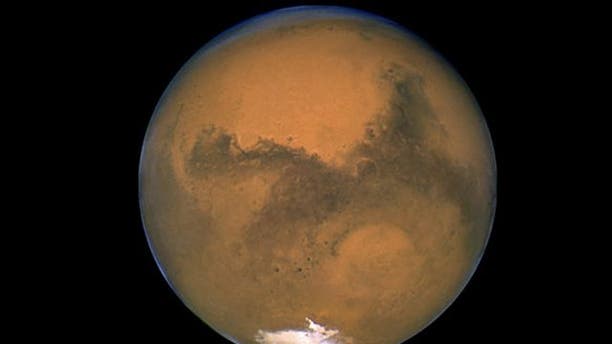
The sci-fi adventure “The Martian” has landed in theaters starring Matt Damon as an astronaut forced to find ways of surviving on Mars solo after being left behind by his crew. The film is based on the popular book by Andy Weir and provides many science based explanations of how he could live on the red planet.
When FoxNews.com spoke with Director Ridley Scott at the Toronto International Film Festival we asked him about this Mars fascination. “I think because Mars really is the nearest planet, you discount the moon, which is only five days away, five days flight,” he said. “Mars, according to where you are, is between 50 million and 130 million miles away, according to its trajectory. After that, you got to learn to hibernate for years and you got to fly at the speed of light to get to the next planet. You’d be flying for 40 years.”
Scott describes manned Mars exploration as “a quantum leap”, further fueling our fascination with the planet. “NASA now knows that there is a massive glacier and therefore several massive glaciers of pure water underneath the sand on Mars,” he said. “So one does ask the question - 'a billion years ago, was Mars like us'?”
Now with the recent discovery of flowing liquid water on Mars, scientists may be closer to answering that question than ever before.
Scott also discussed how he came up with an on-screen Mars that audiences can see in both 2D and 3D. The director said he had plenty of material to help him design the cinematic planet. “I looked at all the stuff, the material that they’d had coming off Mars over the last 30 years, quite a lot actually, and they got a lot of assets lying up there or still working assets,” he said.

Antarctic scientists may face breathalyzer tests in attempt to curb drunkenness


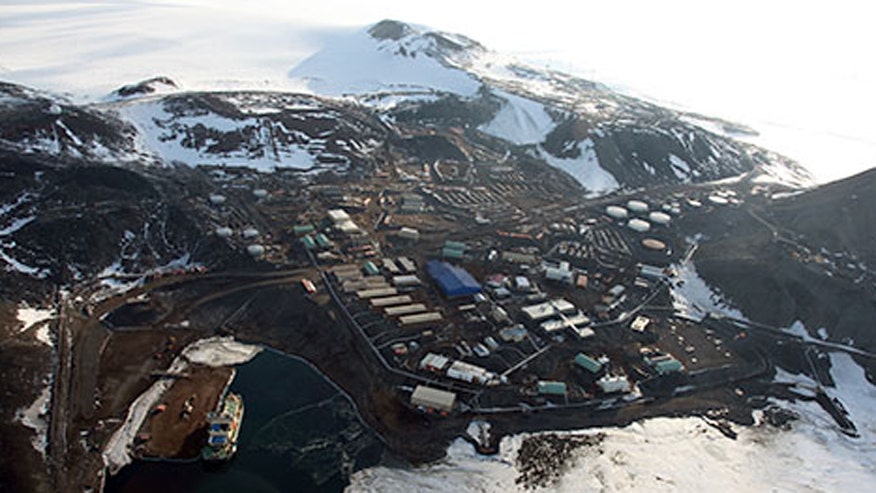
When you’re working in Antarctica, you can only play so much Xbox before the walls begin to close. However, a recent safety audit released by the National Science Foundation Office of the Inspector General has sounded the alarm regarding over consumption (and in some cases, creation) of alcohol at U.S. Antarctic research bases. 
From May 2014 to March 2015, the organization conducted an audit of the U.S. Antarctic Program (USAP) at three research stations – McMurdo, Amundsen-Scott South Pole, and Palmer. Around 3,200 people participate in USAP every year, including contractors, subcontractors and researchers, as well as U.S. military personnel, NSF staff and visitors.
According to the report, some participants flout the alcohol rules fairly openly. 
Although both the USAP and contractor Lockheed Martin prohibit drinking on the job, officials on a visit to a science lab uncovered, “large quantities of bottled beer stored under a desk and in the refrigerator.” It doesn’t end there. Investigators learned that, “a researcher was brewing the beer at the station, which is also prohibited by the USAP Alcohol Policy.” 
Curtailing drinking on the job is only one challenge. The report continues, “NSF officials acknowledged that alcohol consumption in the USAP can create unpredictable behavior that has led to fights, indecent exposure, and employees arriving to work under the influence. However, we noted that breathalyzer tests are rarely administered to determine if employees are intoxicated.”  
In terms of over imbibing and its aftermath, auditors interviewed HR managers for three contractors that account for an estimated 90 percent of the contractor and subcontractors, only one sent an employee for alcohol testing. “Similarly, we interviewed the physicians at all three stations and the USAP Chief Medical Officer, and only one physician recalled a situation, in which an HR manager asked the medical staff to perform a breathalyzer test,” the report added.
Auditors called for more effective use of breathalyzers in the bases. “Since alcohol abuse does occur in the USAP program, workplace safety could be enhanced if breathalyzer tests were administered to all USAP participants endangering themselves or others due to the influence of alcohol,” it said. “We recommend that NSF review the legality of a requirement for breathalyzer for all USAP participants and establish and enforce a requirement to the extent it is legal.”
The National Science Foundation has not yet responded to a request for comment on this story from FoxNews.com. Lockheed Martin referred FoxNews.com to the National Science Foundation for comment.

Jumat, 25 September 2015

NASA to announce 'major science finding' about Mars Monday


The scientific community is in speculation overdrive ahead of a scheduled Monday announcement by NASA of a "major science finding" related to Mars.
The specific nature of the discovery won't be revealed until a scheduled 11:30 a.m. ET press conference at NASA headquarters in Washington. However, the roster of participants includes two authors of a paper that claimed images taken from orbit show flowing water on the surface of the Red Planet, prompting rumors that the announcement relates to the possible discovery of water in its liquid form.
Those authors — Lujendra Ojha of the Georgia Institute of Technology in Atlanta and Alfred McEwen, principal investigator for the High Resolution Imaging Science Experiment at the University of Arizona in Tucson — published their paper on the subject in 2011, when Ojha was still an undergraduate at the University of Arizona. 
Scientists have long known that there is frozen water at Mars' poles, but they have never discovered liquid water. Any such discovery would have huge consequences for future expeditions, including NASA's goal of sending a manned mission to Mars by the 2030s.
"If they’re announcing that they’ve found easily accessible, freely flowing liquid water under the surface — which is one of the theories we’ve been hearing for years and years — that has massive implications both for the potential for life on that planet and sustainability of humans," Doug McCuistion, the former head of NASA’s Mars program, told the Boston Herald. "That would be highly enabling and might be the game-changing trigger for both finding life and hurrying up and getting people to Mars."

Mars has flowing liquid water, NASA confirms

NASA has confirmed the existence of flowing liquid salty water on Mars, fueling the possibility of life on the Red Planet.

“Today, we’re revolutionizing our understanding of the planet,” said Jim Green, director of planetary science at NASA Headquarters in Washington, during a press conference Monday. “Mars is not the dry, arid planet that we thought of in the past - under certain circumstances, liquid water has been found on Mars.”
Speculation has been mounting that NASA’s announcement would involve flowing water. Scientists have long known that there is frozen water at Mars' poles, but they have never discovered liquid water. The discovery could have huge consequences for future expeditions, including NASA's goal of sending a manned mission to Mars by the 2030s.
Scientists have based their findings on an analysis of the mysterious dark streaks on Mars’ surface called Recurring Slope Lineae (RSL). The streaks have intrigued scientists for some time, fading during cooler months and recurring annually at nearly the same locations. “The dark streaks form in late spring, grow through the summer and disappear by the fall,” explained Michael Meyer, lead scientist for the Mars Exploration Program at NASA Headquarters.

Kamis, 24 September 2015

European astronaut uses 'the Force' to control rover from space


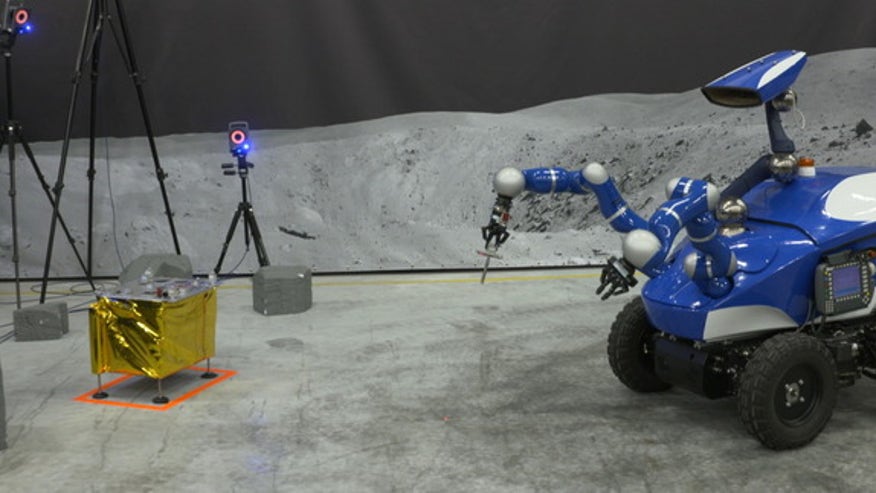
Demonstrating one small step for rover operations, a European astronaut successfully maneuvered a machine on Earth in precision operations from his perch 248 miles high on the International Space Station.
Sept. 7, the European Space Agency (ESA) astronaut Andreas Mogensen helped demonstrate the first "force feedback" using a rover controlled from space. With the help of a system that let him feel forces pressing against the rover's arm, Mogensen remotely inserted a small, round peg into a "task board" that offered just a fraction of a millimeter of clearance.
"Andreas managed two complete drive, approach, park and peg-in-hole insertions, demonstrating precision force-feedback from orbit for the very first time in the history of spaceflight," experiment leader André Schiele of ESA's Telerobotics and Haptics Laboratory said in a statement. [Video: Space-Borne Astronaut Runs Robot On Earth]
"He had never operated the rover before, but its controls turned out to be very intuitive," Schiele said in the statement. "Andreas took 45 minutes to reach the task board and then insert the pin on his first attempt, and less than 10 minutes on his follow-up attempt, showing a very steep learning curve."
Clever engineering allowed the astronaut to "feel" his way around the hole despite there being a 1-second delay between his movements and what was happening on the ground. The team — which included members from the European Space Research and Technology Centre (ESTEC) and graduate students from Delft University of Technology, both in the Netherlands — created software models to compensate for the lag.